Closest MBTI
INTP / INTJ
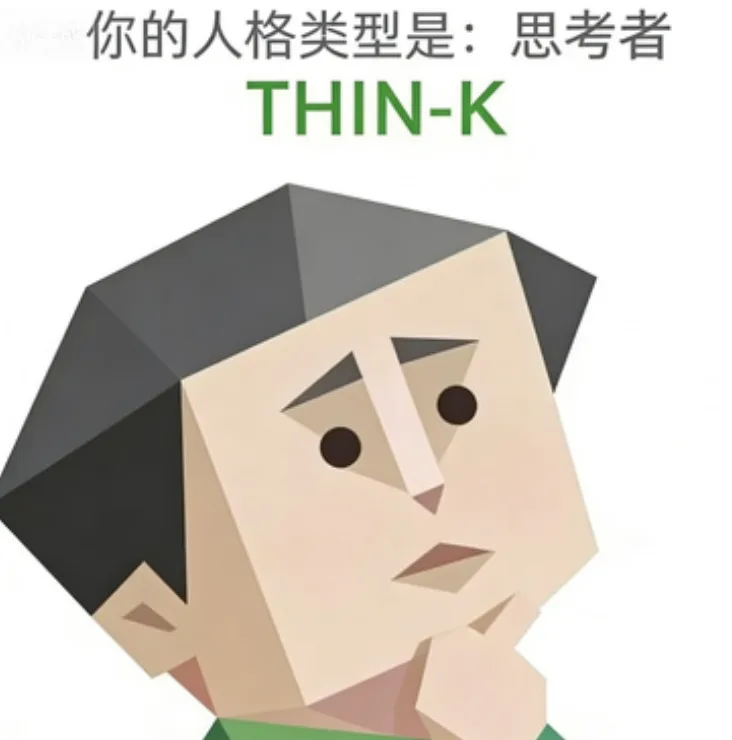
The Thinker looks closest to INTP / INTJ in the MBTI mirror
THIN-K has a courtroom permanently in session inside the head. It is not that you overthink. It is that you think in three more dimensions than most people do. When others are asking, "What should I have for lunch?", you are asking, "Why do human beings even need the concept of lunch?"
Closest MBTI
INTP / INTJ
Why it feels close
THIN-K feels closest to INTP / INTJ mainly along the Direction of thinking line: infinite divergence, systematic convergence and trial with high sense of meaning.
Biggest difference
The real split is not the label match itself, but the fact that SBTI and MBTI explain Direction of thinking with different internal logic.
SBTI lens
THIN-K, there is a court that is always in session in his head. You’re not thinking too much, you’re thinking in three more dimensions than others. When others are thinking "What to have for lunch", you are thinking "Why do humans need the concept of lunch".
MBTI lens
INTP
INTPs are MBTI's logicians, and probably the type with the highest dimensional overlap with THIN-K. The core engine is the same in both: Ti (Introverted Thinking) driving an endless loop of analysis.
But here is the difference: INTP thinking is curiosity-driven. Ne throws up a question, Ti dissects it, and then another question appears. The cycle continues, but each step contains a certain intellectual pleasure. THIN-K thinking carries relatively high A3 (sense of meaning / life significance). It is not merely curious. It is genuinely trying to figure out what any of this means.
INTP thinks because it is fun. THIN-K thinks because not thinking feels impossible.
If you are THIN-K + INTP, your thought process resembles a search engine that cannot be shut off, but with an extra layer of existential heaviness that ordinary INTP often lacks. You do not only want to know how things work. You want to know why they should work at all. That makes your inner life heavier, but also deeper. You are the sort of person who solves something at 3 a.m., loses sleep from excitement, then wakes up and thinks, "Great. But what practical use was that?"
INTJ
INTJs also think deeply, but Ni + Te gives them something INTP does not naturally have: directionality. INTJ thinking converges. The analysis ultimately points toward a strategic objective.
That is where THIN-K differs. THIN-K's Ac (action drive) is not high across the board like BOSS's, and Ac2 (decision style) may be slower. That makes THIN-K closer to "thinking as an end in itself" than "thinking in order to act."
INTJ thinks, draws up the blueprint, and executes. THIN-K thinks, finds a new question, and keeps thinking.
If you are THIN-K + INTJ, you have INTJ's systematic vision but less of the inner compulsion to force everything into reality. You can see the whole board, but you often enjoy reviewing the game more than playing it. Your insight is first-rate. You may just need a BOSS- or GOGO-type person to turn that insight into something tangible.
Dimension translation
This section handles the same outer behavior and explains why SBTI and MBTI may read it as two completely different inner motivations.
| Collision point | SBTI says | MBTI says | In plain English |
|---|---|---|---|
| The price of thinking | A3 = H (strong sense of meaning) but Ac2 = slower (thinks so much it stalls action) | INTP: analysis paralysis; INTJ: rarely paralyzed because Ni locks direction | THIN-K's depth of thought is both gift and trap. You see more clearly than most people, but "seeing through" something is not the same as "walking through" it. Your brain is a high-end computer with too many processes open in Task Manager. |
| Role in social settings | So dimensions slightly below midpoint | INTP: says little, but it is all substance; INTJ: says even less, but every sentence sounds final | In social settings, THIN-K is usually the person who barely speaks, but the moment they do, the whole room goes quiet. Not because you are eloquent, but because what you said takes everyone else five minutes to process. |
| Handling emotion | E1 = medium (not especially anxious, not numb either) | INTP: emotions are bugs to debug; INTJ: emotions are variables to manage | SBTI places your emotional profile in the middle: not cold-blooded, not hot-blooded. Ti-heavy MBTI types often treat emotions like code. Have you noticed that "analyzing your feelings" sometimes comes more naturally to you than simply feeling them? |
Soul check
Question 1
Have you ever considered this: how much of your "deep thinking" is genuine inquiry, and how much of it is an excuse to avoid action? "I haven't thought it through yet" is the most dignified form of procrastination in the world-and you are smart enough to invent a hundred excellent reasons why you supposedly still haven't thought it through.
Question 2
If someone asks, "Are you happy?" is your first instinct to answer, or to define what "happy" means first? INTP would enter definition mode. INTJ would think the question is inefficient. What about you? How long has it been since you felt an emotion without first thinking your way around it?
Question 3
Does your thinking have an endpoint? Not the endpoint of "I figured it out," but the endpoint where you are willing to accept that some things will never fully make sense-and that this is okay. If your thinking never ends, then perhaps you are not searching for an answer. Perhaps you are avoiding the fact that there may not be one.