Self Model
S1 Self-worth & Confidence
H
You have a fairly stable sense of yourself and random strangers are not enough to scatter it.
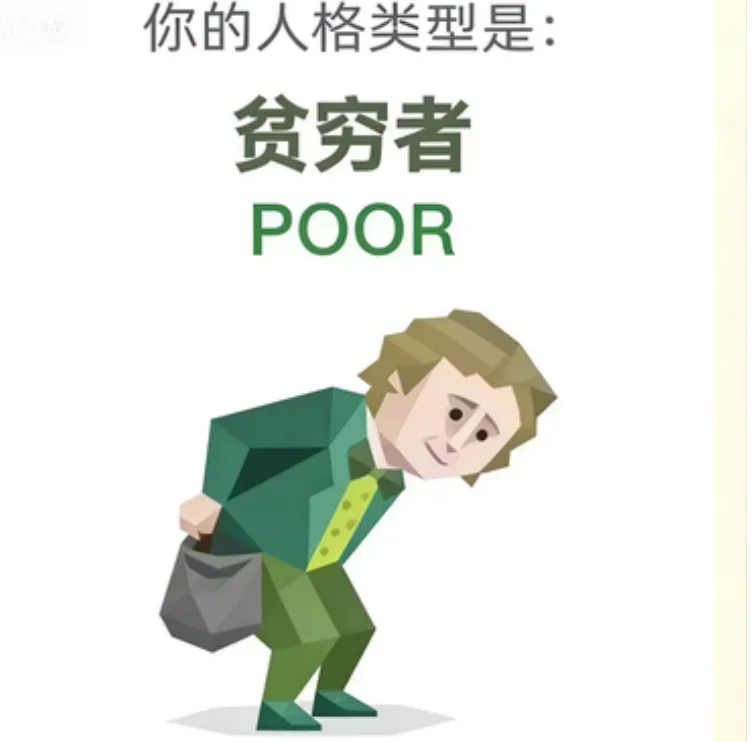
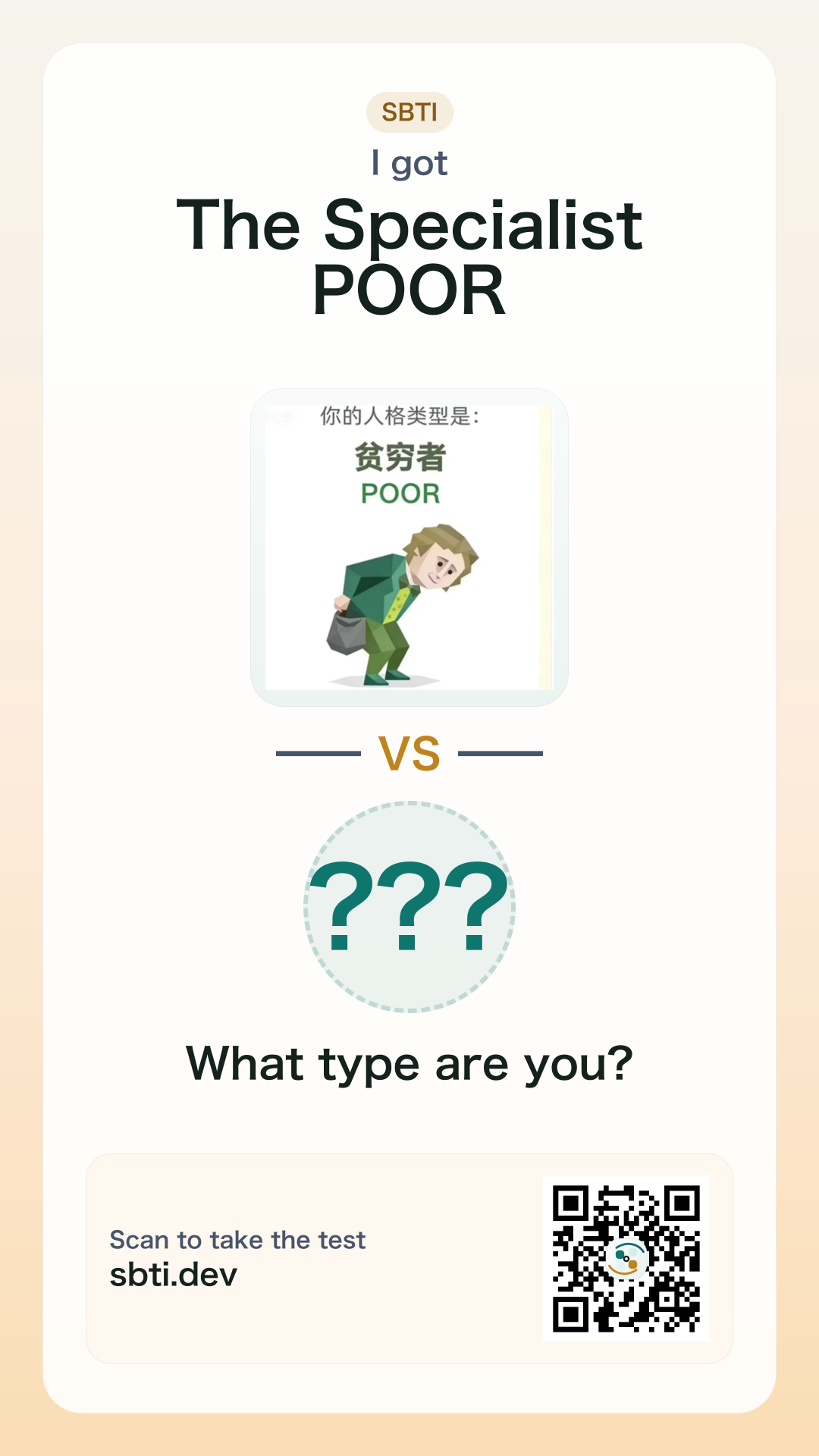
I’m broke, but I’m focused.
Quick read
POOR does not mean your wallet got sentenced. It means your desires have gone through ruthless downsizing. While other people scatter their attention like QR codes all over the sky, you compress yours into a single laser beam. The world of POOR is simple: irrelevant things get muted, important things get drilled hard. Noise, vanity, social performance, random networking? Sorry, no bandwidth. It may look like scarcity from the outside, but in practice it is concentration so intense it starts to resemble mining equipment.
This type’s 15-dimension fingerprint
Self Model
S1 Self-worth & Confidence
You have a fairly stable sense of yourself and random strangers are not enough to scatter it.
Self Model
S2 Self-clarity
You know your temper, your wants, and your bottom lines pretty well.
Self Model
S3 Core Values
Comfort and safety matter more. Life does not need to run in sprint mode every day.
Emotion Model
E1 Attachment Security
Half trust, half testing. Emotional tug-of-war is common inside you.
Emotion Model
E2 Emotional Investment
You invest emotionally with restraint. The door is not locked, but security is strict.
Emotion Model
E3 Boundaries & Dependence
Space matters. No matter how much you care, you still need a zone that stays yours.
Attitude Model
A1 Worldview Bias
You view the world through a defensive filter: suspicion first, closeness second.
Attitude Model
A2 Rules & Flexibility
You follow rules when it makes sense and flex when it doesn’t.
Attitude Model
A3 Sense of Meaning
You move with more direction and usually know roughly where you are trying to go.
Action Model
Ac1 Motivational Direction
Results, growth, and momentum light you up more easily.
Action Model
Ac2 Decision Style
You decide fast and dislike revisiting the same choice over and over.
Action Model
Ac3 Execution Pattern
You have a strong urge to push things through. If something stays unfinished, it feels like a thorn in your brain.
Social Model
So1 Social Initiative
Your social engine warms up slowly. Initiating contact usually takes effort to gather.
Social Model
So2 Interpersonal Boundaries
Your boundaries run strong. If someone gets too close, your body instinctively steps back first.
Social Model
So3 Expression & Authenticity
Your expression is direct. If it is in your heart, you usually do not enjoy wrapping it in loops.
Core traits
Attitude Model
You view the world through a defensive filter: suspicion first, closeness second.
Attitude Model
You move with more direction and usually know roughly where you are trying to go.
Action Model
Results, growth, and momentum light you up more easily.
This type’s 15-dimension fingerprint
Self Model
S1 Self-worth & Confidence
You have a fairly stable sense of yourself and random strangers are not enough to scatter it.
Self Model
S2 Self-clarity
You know your temper, your wants, and your bottom lines pretty well.
Self Model
S3 Core Values
Comfort and safety matter more. Life does not need to run in sprint mode every day.
Emotion Model
E1 Attachment Security
Half trust, half testing. Emotional tug-of-war is common inside you.
Emotion Model
E2 Emotional Investment
You invest emotionally with restraint. The door is not locked, but security is strict.
Emotion Model
E3 Boundaries & Dependence
Space matters. No matter how much you care, you still need a zone that stays yours.
Attitude Model
A1 Worldview Bias
You view the world through a defensive filter: suspicion first, closeness second.
Attitude Model
A2 Rules & Flexibility
You follow rules when it makes sense and flex when it doesn’t.
Attitude Model
A3 Sense of Meaning
You move with more direction and usually know roughly where you are trying to go.
Action Model
Ac1 Motivational Direction
Results, growth, and momentum light you up more easily.
Action Model
Ac2 Decision Style
You decide fast and dislike revisiting the same choice over and over.
Action Model
Ac3 Execution Pattern
You have a strong urge to push things through. If something stays unfinished, it feels like a thorn in your brain.
Social Model
So1 Social Initiative
Your social engine warms up slowly. Initiating contact usually takes effort to gather.
Social Model
So2 Interpersonal Boundaries
Your boundaries run strong. If someone gets too close, your body instinctively steps back first.
Social Model
So3 Expression & Authenticity
Your expression is direct. If it is in your heart, you usually do not enjoy wrapping it in loops.
Core traits
Attitude Model
You view the world through a defensive filter: suspicion first, closeness second.
Attitude Model
You move with more direction and usually know roughly where you are trying to go.
Action Model
Results, growth, and momentum light you up more easily.
Similar Types
This is the better version of 'keep browsing': not random extra pages, but types that usually overlap in mood, coping style, or overall energy with the one you just opened.
SBTI × MBTI
A lot of people arrive here from MBTI first, so this section works as a bridge rather than a conversion chart.
If you think in MBTI first, POOR usually feels closest to ISFP or INFP. The interesting part is not the label match itself, but where SBTI and MBTI start explaining the same behavior with different internal logic.
FAQ
I’m broke, but I’m focused. POOR does not mean your wallet got sentenced. It means your desires have gone through ruthless downsizing. While other people scatter their attention like QR codes all over the sky, you compress yours into a single laser beam. The world of POOR is simple: irrelevant things get muted, important things get drilled hard. Noise, vanity, social performance, random networking? Sorry, no bandwidth. It may look like scarcity from the outside, but in practice it is concentration so intense it starts to resemble mining equipment.
If this result feels close, the most useful nearby pages to compare next are OH-NO (The Alarmist), SHIT (The Malcontent), CTRL (The Handler). They tend to sit nearest in mood, coping style, or overall behavioral energy.
POOR usually gets bridged to ISFP / INFP inside an MBTI context. This is not a one-to-one conversion, but a reading aid for understanding where the overlap starts and where the two systems split.
Share Card
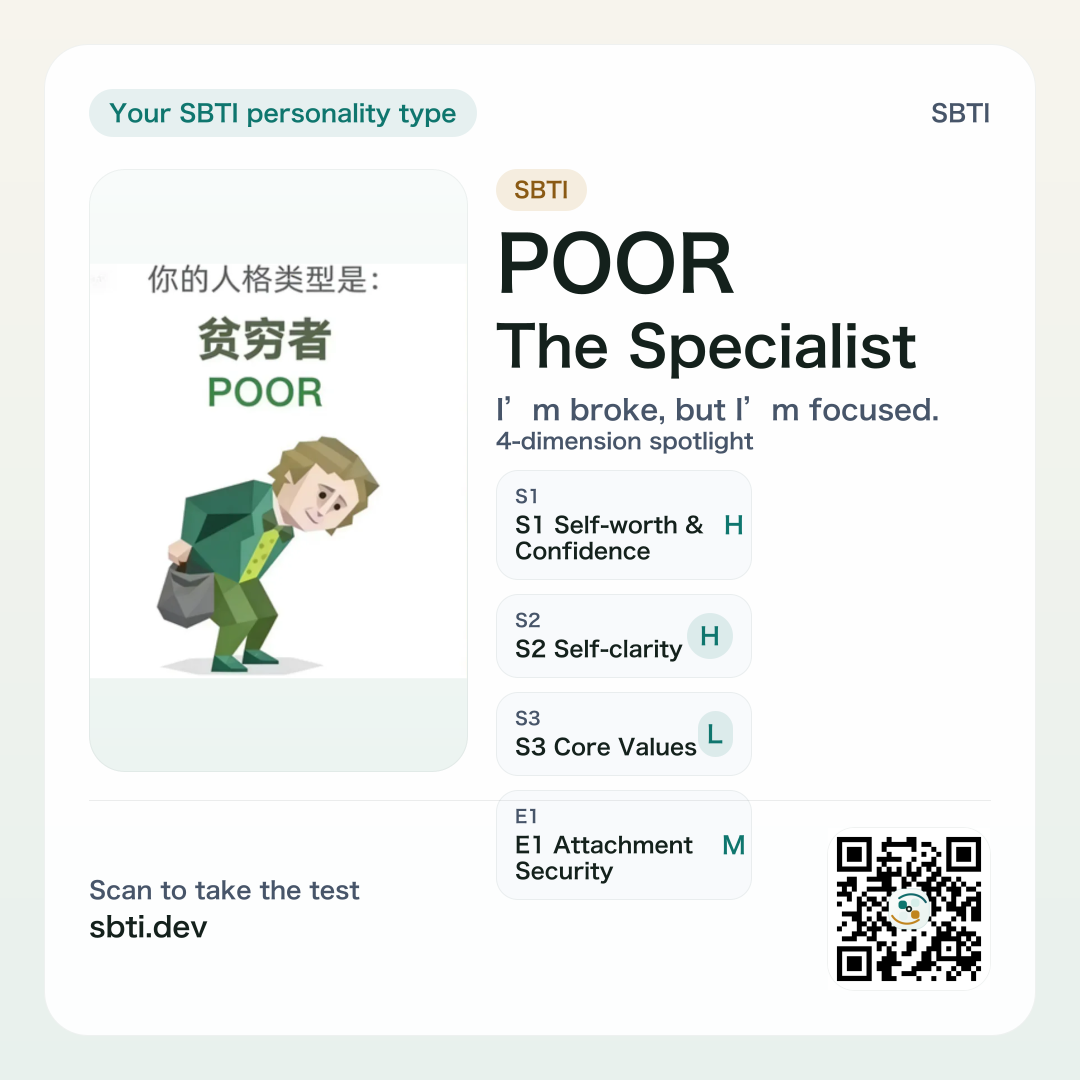
This square card is designed for chat screenshots, group drops, and fast social sharing. It grabs attention faster than a naked link.
Long-press the preview on mobile, or use the save button below.
Challenge Friends
You got POOR (The Specialist). Now drag a friend in, let them test, and compare who turned out more unhinged.
The poster already includes a QR code, so it works well in stories and group chats.
0 people have already sent this challenge to a friend
SBTI rankings
The leaderboard only counts results that users manually confirm and submit from the result page. It does not auto-record every visitor.