Closest MBTI
ESFJ / ISFJ
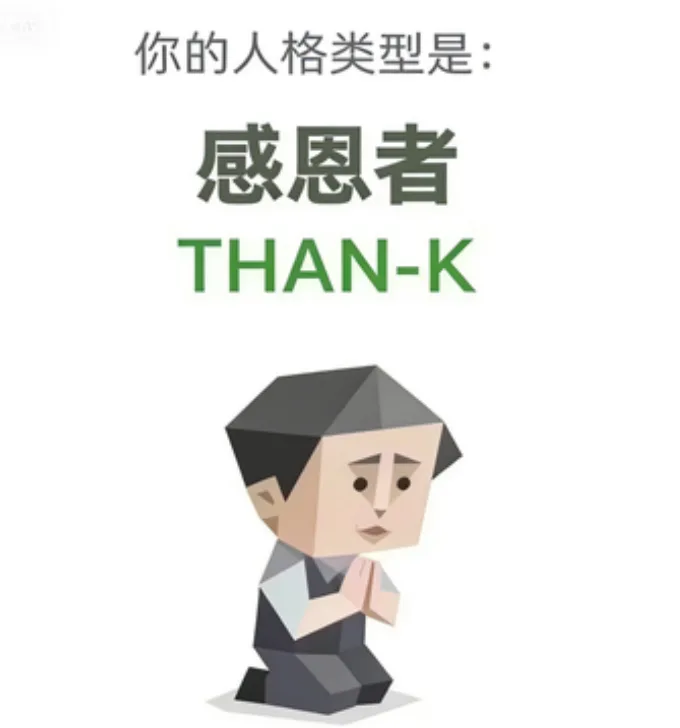
The Thankful One looks closest to ESFJ / ISFJ in the MBTI mirror
THAN-K is the person in the crowd with a built-in warm-light filter. It is not that you are unaware of the world's dark side-you are. You simply choose to see the light first. Your gratitude is not naïveté. It is a form of optimism that has been thought through carefully.
Closest MBTI
ESFJ / ISFJ
Why it feels close
THAN-K feels closest to ESFJ / ISFJ mainly along the Forms of gratitude line: social expression, silent giving, and optimistic engagement.
Biggest difference
The real split is not the label match itself, but the fact that SBTI and MBTI explain Forms of gratitude with different internal logic.
SBTI lens
THAN-K, the person in the crowd who has his own warm light filter. It’s not that you don’t know there’s a dark side to the world – you know, you just choose to see the light first. Your gratitude is not naive, it is a well-thought-out optimism.
MBTI lens
ESFJ
ESFJs are MBTI's consul type. Fe + Si makes them naturally attentive to other people's feelings and highly aware of everyone who has ever helped them. What they share with THAN-K is that both can receive one milk tea and respond with a two-hundred-word message of thanks.
The difference is that ESFJ gratitude is an Fe-driven social behavior. Expressing thanks is one of the ways they maintain relationships. THAN-K's gratitude comes more from an optimistic A1 (worldview) and relatively high E2 (emotional investment). It is not social strategy. It is, "I truly do feel this deserves gratitude."
ESFJ says thank you because it is the proper thing to do. THAN-K says thank you because the heart is genuinely full of thanks.
If you are THAN-K + ESFJ, you are the kind of person others feel becomes better company the longer they stay with you. Your gratitude is contagious. Have dinner with you once, and even the server may end up moved by your sincerity. But your blind spot is this: gratitude can become a burden. You begin to feel indebted to the whole world, and secretly plan to repay every last debt.
ISFJ
ISFJ gratitude is quieter. Si remembers each detail, Fe wants to give something back, but it may not always be spoken aloud. What overlaps with THAN-K is that both carry a "someone was kind to me, and I will remember it forever" quality.
The difference is that ISFJ often expresses gratitude through action: remembering your birthday, helping pack your bags, silently refilling your water when you are not looking. THAN-K may express gratitude more directly, because SBTI suggests less awkwardness in direct expression.
ISFJ says thank you through action. THAN-K says it through both action and words.
If you are THAN-K + ISFJ, you are the kind of person who helps a friend move until midnight and then sends a message the next day saying, "Thank you for letting me help." Your logic is that being needed is itself a gift. But have you noticed how rarely you allow others to return that same kind of care to you? For you, receiving help can feel harder than giving it.
Dimension translation
This section handles the same outer behavior and explains why SBTI and MBTI may read it as two completely different inner motivations.
| Collision point | SBTI says | MBTI says | In plain English |
|---|---|---|---|
| The base tone of optimism | A1 = high (trust in the world's goodwill), A3 = medium-high | ESFJ: optimistic because social feedback is good; ISFJ: optimistic because used to focusing on the good side | THAN-K is not optimistic because your world is flawless. Your world may be as imperfect as everyone else's. The difference is that your internal filter chooses to notice the good parts first. That is both a gift and a deliberate choice. The question is whether it is sustainable. |
| The cost of gratitude | E2 = high + E3 = medium-low (high investment, weaker boundaries) | ESFJ: may over-give and get used; ISFJ: may over-carry and burn out | SBTI hints at a danger MBTI often understates: gratitude can make it hard for THAN-K to say no. If someone has been kind to you, you may feel you have no right to refuse them. But you do. |
| Self-care | S1 = medium (self-worth is not low, but not especially high either) | ESFJ: self-worth comes from being needed; ISFJ: self-worth comes from being dutiful | Has THAN-K ever felt that it is more grateful toward others than toward itself? You thank the whole world and forget to thank yourself. But after everything you have done, you deserve to be remembered by yourself too. |
Soul check
Question 1
Has gratitude ever turned you into someone who feels "not allowed" to be unhappy? As if you think, "I already have so much. What right do I have to be dissatisfied?" But gratitude and unhappiness are not contradictions. You can be grateful for what you have and still admit that you are tired.
Question 2
Have you ever felt deeply grateful to someone who did not really deserve it? Not because your judgment failed, but because your gratitude system is too easily activated. Someone treats you decently and you want to repay it with your soul, even though some "kindness" is just basic human decency and does not require spiritual debt.
Question 3
Could the person you most need to thank be yourself? You have thanked everyone else. Who is thanking the one who has been giving so much all along?