Closest MBTI
ISFJ / ISTJ
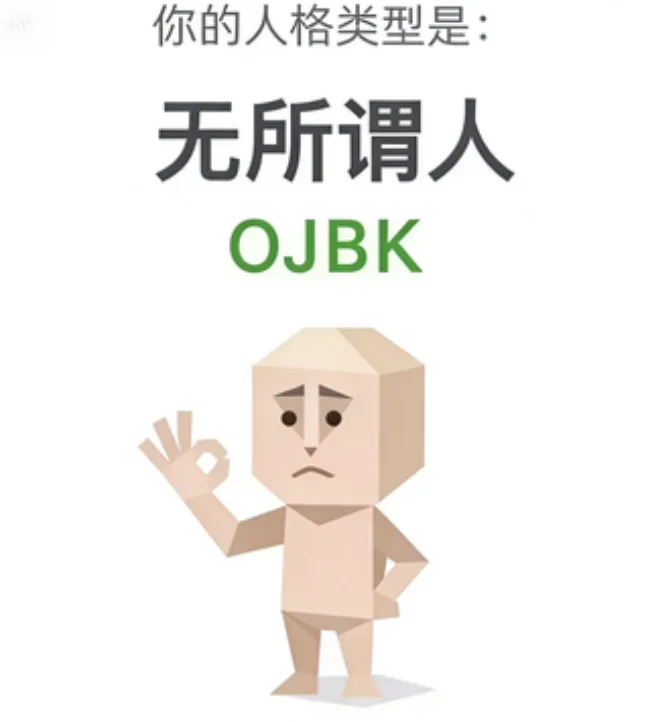
The Whatever Person looks closest to ISFJ / ISTJ in the MBTI mirror
OJBK is human Switzerland. It is not that you have no position. Your position itself is "either way is fine." At dinner, you are the one who says, "Whatever, you decide." Not because you lack opinions, but because your opinion is: "This matter is not worth spending an opinion on."
Closest MBTI
ISFJ / ISTJ
Why it feels close
OJBK feels closest to ISFJ / ISTJ mainly along the The background of "it doesn't matter" line: sense of responsibility, order and all-dimensional moderation.
Biggest difference
The real split is not the label match itself, but the fact that SBTI and MBTI explain The background of "it doesn't matter" with different internal logic.
SBTI lens
OJBK, humanoid Switzerland. It's not that there is no stance, it's that the stance itself is "anything goes." You are the one who says "Whatever, you decide" at a dinner party, not because you don't have an opinion, but because your opinion is "This matter is not worth my opinion."
MBTI lens
ISFJ
ISFJs are MBTI's defenders. Si + Fe helps them remember everyone's birthday, preferences, allergies, and all the little details needed to quietly keep things running. What they share with OJBK is that neither fights for the spotlight. They are both "you all go first, I'll hold the structure together" people.
The difference is that ISFJ "easygoingness" is powered by Fe-they truly care about harmony and are willing to yield personal preference for group comfort. OJBK's "easygoingness" comes from middling scores across the SBTI board. It is not about harmony. It is that your emotional intensity toward most things genuinely sits around the median.
ISFJ's "anything is fine" hides tenderness. OJBK's "anything is fine" hides the truth: it really is fine.
If you are OJBK + ISFJ, you are the kind of person who says nothing if no one asks, but the second someone does ask, you throw yourself into helping. Your presence is low-key, but if you disappear for one day, everyone suddenly notices that nothing works properly. You are the team's Wi-Fi-nobody notices you are there until you cut out and everything collapses.
ISTJ
ISTJs are MBTI's inspectors. Si + Te makes them loyal executors of rules and procedures. What they share with OJBK is a dislike of pointless drama.
The difference is that ISTJ's "I don't stir things up" comes from faith in order: the rules exist, so follow them-why create chaos? OJBK's "I don't stir things up" is more Zen: rules may exist or not exist, causing trouble may happen or not happen-whatever makes life easier is fine.
ISTJ is the law-abiding citizen who follows traffic rules. OJBK is the person who will still wait at a red light even when no cars are coming, because standing there is also fine.
If you are OJBK + ISTJ, your desk is always tidy, but not because you are obsessive-just because you do not own much stuff. Your emotions are like central air-conditioning: usually somewhere between 18 and 22 degrees. Very few people have ever seen your temperature turned up above 30. That is both a strength and a blind spot. You are so steady that people sometimes wonder whether you have any temperature at all.
Dimension translation
This section handles the same outer behavior and explains why SBTI and MBTI may read it as two completely different inner motivations.
| Collision point | SBTI says | MBTI says | In plain English |
|---|---|---|---|
| The underlying tone of your Zen-ness | All 15 dimensions sit at the midpoint | ISFJ: outwardly calm, inwardly keeping score; ISTJ: outwardly calm, inwardly calculating | MBTI's "introverted + sensing" types still have a center of gravity-they care about order and relationships. OJBK is true lack of center. It is not that you care about nothing. It is that your level of care is distributed so evenly that no single thing breaks the threshold of "this actually matters." |
| Conflict response | So2 = medium (boundaries neither weak nor strong) | ISFJ: gets hurt but says nothing; ISTJ: reasons until the other person gives in | OJBK's response to conflict is "Oh, okay then." That is not suppression. You genuinely feel that the matter is not worth upgrading into conflict. But in the long run, does "nothing is worth it" make you miss the few things that really are worth fighting for? |
| Presence | Midpoint across all dimensions = not sharp = easy to overlook | ISFJ: gets hurt when overlooked but says nothing; ISTJ: does not care unless it interferes with work | OJBK's low presence does not mean you are unimportant. It means you lack edges. Everything has been polished into a smooth middle state. Have you ever considered that being sharp once in a while may not be a bad thing? |
Soul check
Question 1
Do you truly not care, or is not caring simply safer? If nothing matters, then nothing can hurt you. ISFJs may not admit this, but they know it. ISTJs think the question is too sentimental and would rather not answer. What about OJBK? Is your "whatever" wisdom, or armor?
Question 2
Is there something you actually want very, very badly, but have never told anyone? Because the moment you say it aloud, you stop being OJBK. You become "a person with desire." Desire means the possibility of not getting what you want. Not getting it means disappointment. And disappointment is exhausting, right?
Question 3
What if your all-midpoint profile is not natural temperament, but a learned defense? Perhaps the younger you once had moments of wanting something intensely. What taught you to move every dial back to the middle?