Closest MBTI
ENFP / ESFP
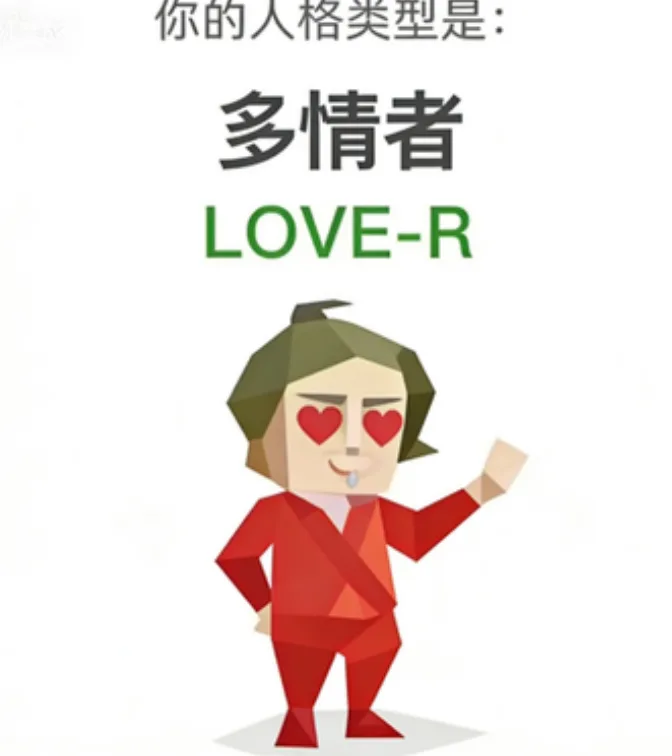
The Romantic Extremist looks closest to ENFP / ESFP in the MBTI mirror
LOVE-R is an extreme-sports athlete in the field of romance. You love at three times other people's intensity, and your heartbreak goes three times deeper too. You are not fickle. You are simply too serious every single time-serious enough that when a relationship ends, it feels like something has been torn out of your soul.
Closest MBTI
ENFP / ESFP
Why it feels close
LOVE-R feels closest to ENFP / ESFP mainly along the Levels of passion line: possibility addiction, sensory addiction, and high commitment and low boundaries.
Biggest difference
The real split is not the label match itself, but the fact that SBTI and MBTI explain Levels of passion with different internal logic.
SBTI lens
LOVE-R, the extreme athlete in the field of love. You fall in love three times more intensely than others, and your heartbreak is three times as deep. You are not a playboy - you are too serious every time, so serious that when the relationship ends, you feel like your soul has been torn out.
MBTI lens
ENFP
ENFP's romanticism comes from Ne. In every person they can see a new possibility, and in their imagination each relationship has already played out like a thirty-episode drama. Their overlap with LOVE-R lies in this: neither is shallow. Both are too easily moved by potential.
The difference is that ENFP often falls in love with a person's possibility rather than their reality. LOVE-R's extremely high E2 (emotional investment) means it does not stop at fantasy. You throw your whole self into it. ENFP may conduct the romance in their head. LOVE-R throws the entire body into the fire.
ENFP writes scripts in love. LOVE-R runs naked through the story.
If you are LOVE-R + ENFP, you may already have imagined baby names within three days of meeting someone. It is not that you lack rationality. Your social feed is probably full of posts about independence and selfhood. But the moment the signal of attraction arrives, your rational center goes into sleep mode. Your love life becomes an epic serial drama: every chapter vivid, every chapter painful.
ESFP
ESFP's love comes from Se + Fi. They invest fully in every second of the present. Their hugs are tight, their laughter is loud, and when they leave... they can leave completely. Their overlap with LOVE-R lies in the sheer intensity of emotional experience.
The difference is rhythm. ESFP love is fireworks-brilliant, immediate, with no guarantee of tomorrow. LOVE-R may have lower E1 (attachment security), meaning its devotion often contains a thread of fear: fear of losing, fear of being left. That makes it more attached and slower to let go than ESFP.
ESFP is the happiest person in the honeymoon phase. LOVE-R is the one who hurts most after the breakup.
If you are LOVE-R + ESFP, you live at maximum emotional resolution. Every detail gets enlarged, stored, and replayed. The first meal, the temperature of the first hand-hold, the final sentence the other person said before leaving-you remember all of it. In love, this memory is a gift. After love, it becomes a curse.
Dimension translation
This section handles the same outer behavior and explains why SBTI and MBTI may read it as two completely different inner motivations.
| Collision point | SBTI says | MBTI says | In plain English |
|---|---|---|---|
| Depth of investment | E2 = extremely high + E3 = low (weak boundaries, blurred you/me) | ENFP: invests in imagination; ESFP: invests in experience | LOVE-R's "romantic excess" is not fully captured by any single MBTI type. You do not merely invest imagination or sensation. You transplant part of your selfhood into the other person. That is why breakup feels like amputation. |
| Sense of security | E1 somewhat low (easy anxiety around abandonment) | ENFP: distracts itself with new possibilities; ESFP: covers anxiety with new stimulation | Low E1 gets to the core: how much of your devotion is love, and how much is using love to fill a gap in basic security? This does not make the love unreal. Your love is real every time. But love may not be the only force driving you to leap in so completely, again and again. |
| Recovery mechanism | S1 = medium (self-confidence wavers after being hurt) | ENFP: quickly drawn to new people or things; ESFP: uses fresh sensory experience to cover pain | LOVE-R heals more slowly than both ENFP and ESFP because your S1 is not high enough to remain untouched. Each wound shakes your sense of self-worth a little. "The next one will be better" is not enough. What really needs repair is the underlying code that asks, "Am I still worthy of being loved?" |
Soul check
Question 1
Have you ever loved a real person, rather than the idealized version in your head? ENFP tends to love projection. ESFP tends to love feeling. LOVE-R is capable of both. What you may fall for is not the person themselves, but the version of yourself that appears in their presence.
Question 2
If a relationship were destined to be calm: no racing heartbeat, no anxious waiting, no 3 a.m. essays-just stability, trust, and perhaps a little boredom-would you call that happiness, or would you feel it does not count as love? Has your idea of love been kidnapped by intensity?
Question 3
About your next relationship: are you ready-not merely to love again, but to love differently? Or do you already know that you will once more throw yourself in fully, get torn apart again, and stand back up in the ruins again? If you know the ending and still jump, that is not just romantic excess. That is courage.