Closest MBTI
ENFJ / ESFJ
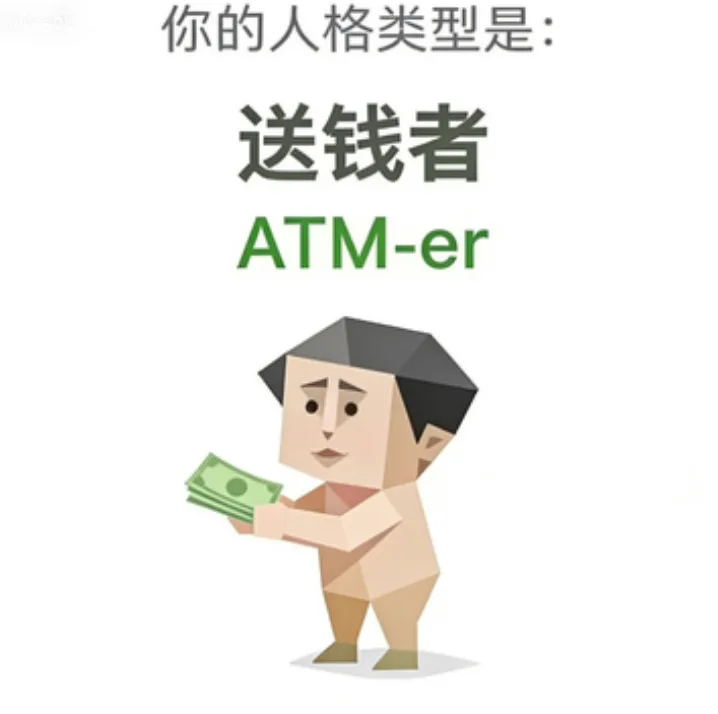
The Human ATM looks closest to ENFJ / ESFJ in the MBTI mirror
ATM-er is a human cash machine. You are not merely generous-generous people still check their account balances. You are the sort who keeps looking for ways to open an overdraft for others after already draining yourself empty. Your giving asks for no return, but the account is bleeding.
Closest MBTI
ENFJ / ESFJ
Why it feels close
ATM-er feels closest to ENFJ / ESFJ mainly along the Giving personality line: emotional coach, logistical manager, high investment and low boundaries.
Biggest difference
The real split is not the label match itself, but the fact that SBTI and MBTI explain Giving personality with different internal logic.
SBTI lens
ATM-er, humanoid cash machine. You're not being generous - generous people also look at the balance. You are the kind of person who "empties himself and still thinks about how to open overdrafts for others." You don’t ask for anything in return for your efforts, but your account is bleeding.
MBTI lens
ENFJ
ENFJs give from Fe + Ni. They sincerely believe they can help others become better, and quite often they can. What overlaps with ATM-er is the strong feeling of, "Whatever you need, I'll provide if I can."
The difference is that ENFJ giving has strategy in it. Ni helps them judge whether a person is worth the investment. ATM-er's extremely low E3 (boundaries / dependence) means that filter is barely installed. Not everyone deserves your resources, but your system lacks a real "refuse" button.
ENFJ is an investor: selectively investing, expecting transformation as a return. ATM-er is a charitable foundation: investing indiscriminately and expecting nothing back.
If you are ATM-er + ENFJ, you are the kind of person who cries harder over a friend's breakup than the friend does, then shows up the next morning with an action plan for healing. Your empathy is strong and your execution is strong, but low E3 means you struggle to tell the difference between helping and over-involving yourself. You help until the other person is embarrassed, and then you still ask, "Is there anything else I can do?"
ESFJ
ESFJ's giving is more practical. Si + Fe makes them remember everyone's needs and quietly act on them. Their overlap with ATM-er lies in the posture of unconditional support.
The difference is that ESFJ giving usually still contains a social expectation of acknowledgment. Their Fe wants appreciation. ATM-er's SBTI profile suggests S1 is not especially high, meaning your giving may not be about recognition at all. It may be more like, "If I stop giving, what proves that I am worth anything?"
ESFJ gives because it improves the relationship. ATM-er gives because without giving, it does not know who it is.
If you are ATM-er + ESFJ, you are the friend group's operations director: you book the restaurant, buy the birthday cake, mediate conflicts, deliver medicine to the sick. Your own needs go to the final line of the list-and then the list becomes so long that you never reach that last line.
Dimension translation
This section handles the same outer behavior and explains why SBTI and MBTI may read it as two completely different inner motivations.
| Collision point | SBTI says | MBTI says | In plain English |
|---|---|---|---|
| What drives the giving | E2 = extremely high + E3 = extremely low + S1 = somewhat low | ENFJ: mission-driven Fe; ESFJ: responsibility-driven Fe + Si | ATM-er's giving goes deeper than standard MBTI descriptions. It may not be mission, and not only duty. It may be a core belief like, "If I'm not giving, I don't deserve to exist." That deserves more serious attention than any tidy type label can offer. |
| Boundary problem | E3 = extremely low (almost no boundaries) | ENFJ: has boundaries but chooses to cross them; ESFJ: has boundaries but opens them from obligation | ENFJ and ESFJ open their boundaries selectively. ATM-er often seems never to have had them installed. This is not just that you chose boundarylessness. It may be that you were never taught what a healthy boundary even looks like. |
| Source of self-worth | S1 medium-low (self-worth tied to giving) | ENFJ: self-worth from influence; ESFJ: self-worth from being needed | All three need outside validation to some degree. ATM-er is the most extreme version: your self-worth comes not merely from "being needed," but from "actively being used." The moment no one needs you, you do not know what is left of you. |
Soul check
Question 1
If tomorrow you stopped giving entirely: no helping, no checking in first, no answering every request-what do you think would happen? What you fear may not simply be "people will leave." It may be "I won't know what to do with myself if I am not giving."
Question 2
Have the people you helped ever hurt you? Almost certainly yes, and probably more than once. Yet next time you will still help. Not because you learned nothing, but because your self-worth system does not permit not helping. That is no longer just kindness. That starts to look like addiction.
Question 3
Final question: who is recharging you? ATMs do not print money from nowhere. You let everyone make withdrawals. Who is making deposits into you? If the answer is "no one," then you are not a human ATM. You are a machine being run into the ground. You deserve someone who puts money back in.